We exceeded our target, raising over £165,000! Thank you so much to everyone who has donated and shared our campaign - we could not have done it without you.
Stanley* is a Patient & Public Involvement (PPI) contributor to Action for ME research projects, including LOCOME and our Big Survey.
Here, Stanley shares his thoughts regarding the opportunities for increased understanding of ME and long Covid through research, and the value that patient involvement can bring to research studies:
Living with long Covid
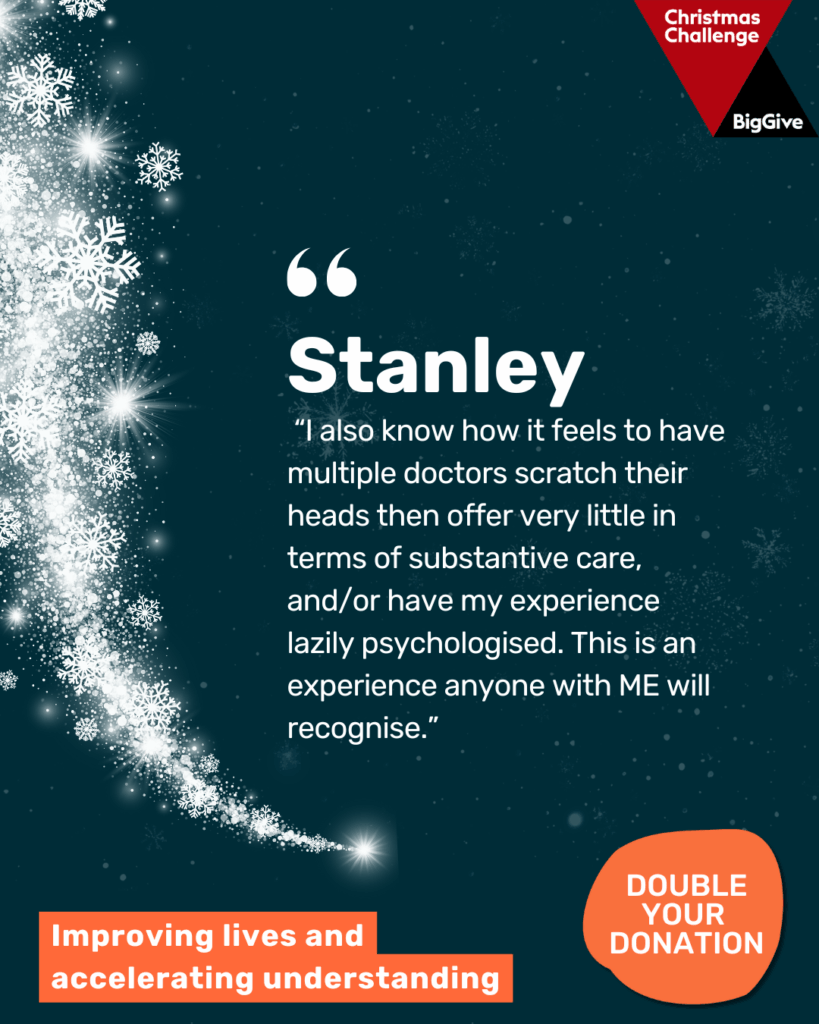
I developed long Covid in 2022 and although not yet diagnosed with ME, I have cornerstone features like post-exertional malaise (PEM) and orthostatic intolerance. I also know how it feels to have multiple doctors scratch their heads then offer very little in terms of substantive care, and/or have my experience lazily psychologised. This is an experience anyone with ME will recognise. Obviously, the tendency by many to psychologise these illnesses is not okay and needs to be challenged. This has become relatively easy thanks to the huge amount of research identifying underlying pathophysiology in long Covid. That is so long as the clinician is willing and resourced to listen and keep up with the latest research, a different challenge altogether.
Stanley’s involvement with research
I’m involved in the LOCOME project and helped to develop the Big Survey. I was a scientist before becoming ill and wanted to maintain a role within science, so this has been a great opportunity that I’ve found really rewarding. I’ve been amazed by how engaged and proactive the long Covid and ME community are, they are ferociously switched on.
The importance of research
Research is fundamental to understanding any condition, especially when it is otherwise proclaimed as ‘too complex’. No, that just means it is under-researched and under-resourced. It’s more undeniable than ever that both ME and long Covid have firm pathologies driving them, some of which appear to overlap, but research is having to play catch up due to historical hostility towards pathophysiological research on post-viral illness, a consequence of poor-quality research favouring psychosocial narratives and politics. There’s now even more urgency to research these conditions due to a huge influx of people with post-viral, infection associated chronic conditions, off the back of Covid infections.
Long Covid has a heterogeneous presentation – but we are starting to understand the myriad ways it can cause chronic illness, and it’s from picking these apart that we will be able to identify solutions (i.e., treatments). It’s the same with ME – we need to identify subpopulations that share disease mechanisms and then target these with precision treatments. Research will allow us to identify biomarkers that will then allow appropriate subpopulations to trial specific treatments, rather than the scatter shot approach as is currently the case, and which often yields disappointing findings.
Why more research funding is desperately needed
Technological advances are allowing us to see what we couldn’t see previously. The answers to ME and long Covid may very well be on the horizon, especially with the advent and accessibility of powerful AI models. I’m cautiously optimistic that we may jump quite quickly forwards in our understanding of IACCs such as ME and long Covid in the next 4-6 years. It’s certainly true that there are more people aware and interested in post-viral illnesses than ever before, they just need the money to support doing quality research. Funding is the bottleneck and government aren’t yet meeting that challenge, although there are glimmers this could be changing. It must, there are too many people affected for them to ignore. In the meantime, as unfair as it is, it’s over to the public.
Why now is the time for more research into ME and Long COVID
It feels like there is a patient-led paradigm shift underway. There is an opportunity here to better understand infection associated chronic conditions like long Covid and ME, more than at any other point in history. More researchers want to work on this, but to do so they need adequate funding for infrastructure and research. Significant investments are needed to reverse what has been described as the ‘biggest medical scandal of the 21st century’ and bring us in line with other similarly disabling and populous conditions. It will help us answers questions like, how are long Covid and ME similar and different? What treatments may work for one, both or neither? Research is the only way to identify this.
We also don’t yet know if different treatments are needed for someone who developed ME post-Covid compared to someone who developed it after Epstein Barr (EBV), a head injury, or environmental exposure – again, this can only be identified through research. What I think we will see in the near future is something that looks more like the model of care used in cancer treatment, where you have different specialists for different types of cancer – they may use similar treatments but in different ways. Perhaps it will be similar with Infection-Associated Chronic Conditions like ME, long Covid, Lyme disease and EBV.
The value of PPI in research projects
PPI can save researchers a lot of time and money so long as you involve us early and often, for example in what questions are relevant and what methods are most effective. We can prevent you embarking on research that has little real-world value and help make research more effective by giving insights you can only really know if you have one of these conditions. This is possible so long as involvement isn’t tokenistic and researchers are committed, resourced and skilled in involving patients throughout the research process.
In the two projects I have been involved with via Action for ME, I’ve been given a front row seat. We are privy to embargoed and confidential information but trusted with this. There have been several occasions during the projects when I have been aware of developments that might be helpful to the project before the researchers. This is why having patients, who routinely have their ear to the ground with respect the goings on in the long Covid and ME world, is vital.
For example, in the LOCOME project, as PPI we have been able to suggest drugs the team might want to interrogate in their genetic models, with the aim of finding candidates that might be worth considering for clinical trials. Patients with long Covid and ME are reliably aware of the treatments people are trialling – whether that is relatively well-known drugs like low dose naltrexone, or experimental drugs yet to be named and only available via clinical trial.
*name has been changed