We are pleased to have funded new research from Dr Audrey Ryback at the University of Edinburgh, co-produced with Simon McGrath, exploring patterns in how and when myalgic encephalomyelitis (ME) develops.
This large-scale study analysed data from more than 9,000 people with ME/CFS, helping to build a clearer picture of the condition’s onset, potential triggers, and links to illness severity.
You can access the paper here.
The study found that ME does not begin at a single, typical age. Instead, there appear to be two peak periods of onset. Researchers also explored factors linked to how ME begins and how severe it becomes.
Main summary from Dr Audrey Ryback:
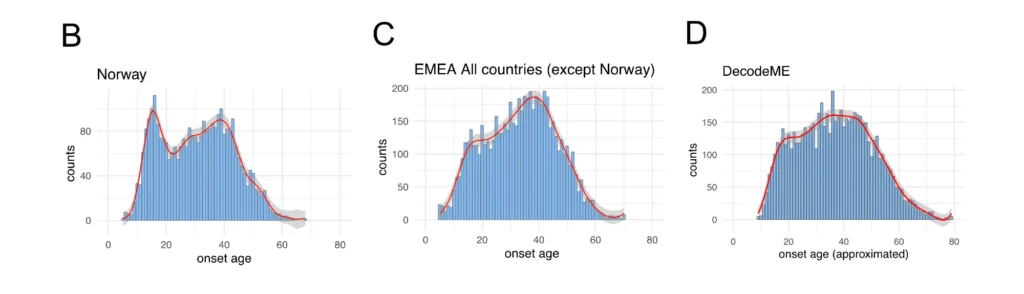
- Researchers found that previous reports of ME having two age peaks in Norway replicates in two different datasets and across 7/10 European countries they examined, suggesting this is a generalisable- and distinctive- feature of ME.
- Evidence was found for a first peak in adolescence and a second peak in early middle age. The average ages for the early and late onset peaks were strikingly similar across countries. Countries did vary in terms of how big the early onset peak was relative to the late one.
- When they compared the features of early and late onset ME, they found that those with early onset ME were more likely to report infection as a trigger, and were more likely to be more severely affected. Those with relatives with ME were also more likely to have early-onset ME.
- Dr Ryback notes an important limitation is that they analysed survey responses, so cannot rule out that biases could affect results. They also only described associations, not causal relationships. But together with the original study from Norway, they think the evidence for two age peaks in ME is now strong.
- The implications of this result are not clear yet. Two onset age peaks is an unusual feature for a disease (most only have one) and might suggest different causes of early and late onset ME, or biological processes changing with age that make it more likely to develop ME at these life stages.
- Future ME research could consider onset age for subgrouping patients.
In this study, researchers were able to validate their findings using data from people who took part in DecodeME. This highlights the vital role that people with ME play in advancing research and improving understanding of the condition.
We are proud to have funded this research and grateful to the researchers - and to everyone who contributed their data and experiences - for helping provide a greater understanding of this debilitating condition, and advancing the field of ME research.
We will continue to support high-quality biomedical research that brings us closer to effective diagnosis, treatment and care for people with ME. You can find out more about this work here.