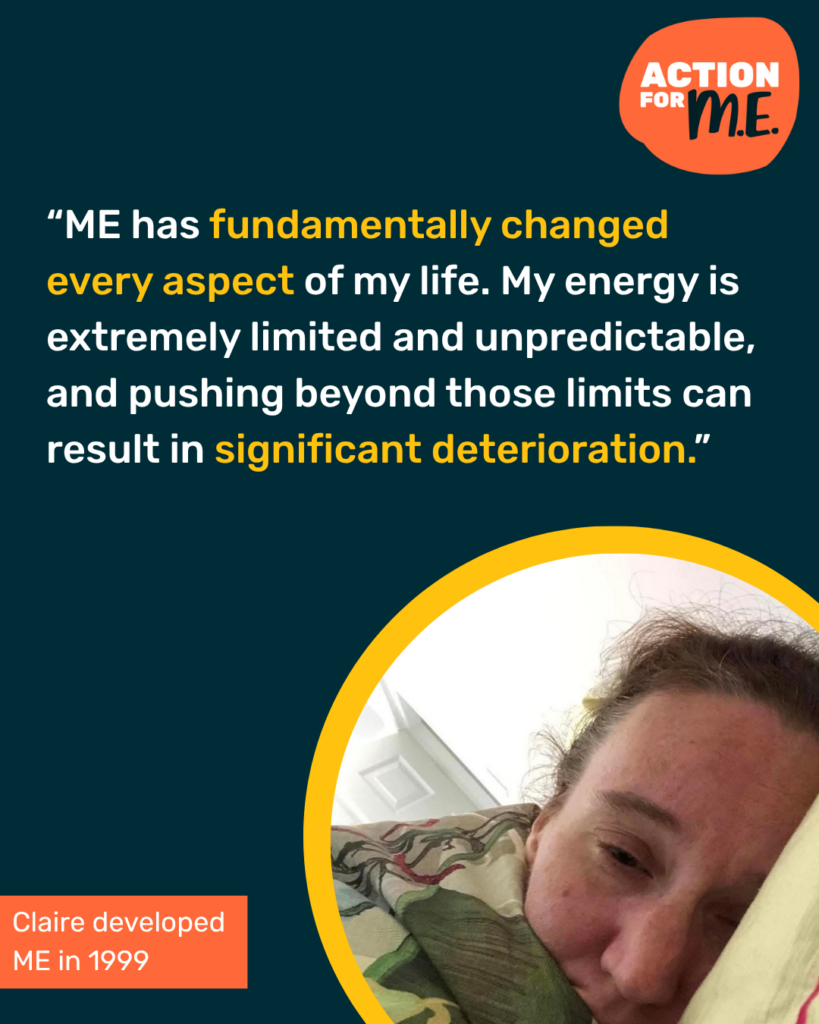
Claire, who lives in North Yorkshire with her husband and daughter, developed ME in 1999 after a bad bout of glandular fever. Claire is moderately to severely affected by ME. Here, she shares her experience of living with ME and participating in the DecodeME research project.
“Before I developed ME, I was active, independent and busy. I was able to work, socialise, exercise and make plans without having to calculate the physical or cognitive cost of everything I did. My world felt open and spontaneous. I could commit to things without worrying about whether I would be well enough to follow through.
My living situation has had to adapt around my illness. Day-to-day life requires careful planning and pacing, and I rely on support with certain practical tasks when my symptoms are worse.
ME has fundamentally changed every aspect of my life. My energy is extremely limited and unpredictable, and pushing beyond those limits can result in significant deterioration. Simple activities that most people take for granted can require recovery time. Social life, work, hobbies and even basic daily tasks now have to be carefully rationed. There is also the emotional impact — the loss of independence, career, opportunities and certainty about the future.
I took part in DecodeME because I want to contribute to meaningful scientific progress. For too long, people with ME have faced misunderstanding and a lack of biomedical research. Participating felt like a way to help move the field forward, not just for myself but for future generations.
When the initial results were published, I felt a sense of validation and cautious hope. Seeing serious, large-scale scientific work focused on ME felt significant. It reinforced that this is a biological illness deserving of rigorous research and proper medical attention.”
Sadly, Claire’s husband Richard has also been unwell for around two years following COVID, and is currently awaiting a diagnosis of ME himself.
“This has been, and continues to be, incredibly difficult for us, as Richard was previously my primary carer. We now have a cleaner who comes once a week to help us manage day-to-day.
One of the hardest aspects of ME is its invisibility and unpredictability. From the outside, someone may look well, but internally they may be managing severe symptoms. The need to constantly pace and avoid deterioration shapes every decision. What I would most like people to understand is that this is not about tiredness — it is a complex, disabling condition that requires understanding, research and appropriate care.”
DecodeME has found that your genes contribute to your chances of developing ME/CFS. We’ve identified eight genetic signals where people with ME/CFS differ from those without, linked to the immune and nervous systems. These landmark findings reflect the lived experience of thousands of people with ME/CFS, providing validation and exciting new avenues for research.
Thank you to all our participants and supporters who made this possible, and to Claire for sharing her story.