

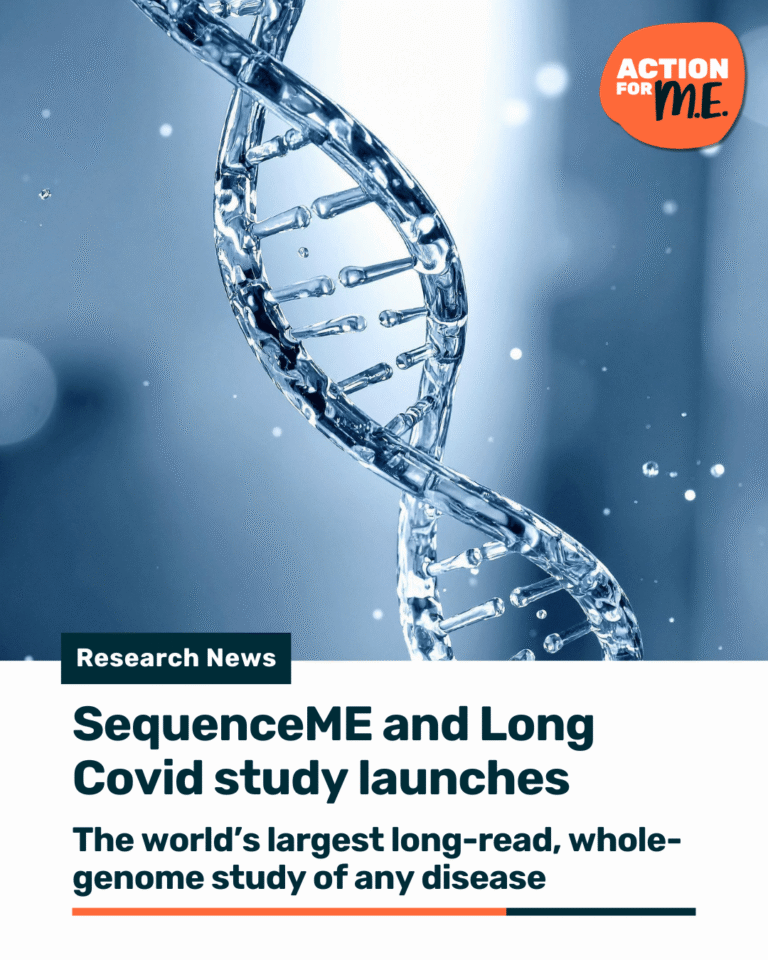
Sequence ME & Long Covid launches
Action for ME, the Schmidt Initiative for Long COVID, and the Complex Disorders Alliance (CODA) announce the launch of Sequence ME &...

Sequence ME & Long Covid, a new research initiative designed to explore the root causes of Myalgic Encephalomyelitis (ME) and Long Covid using large-scale, long-read whole-genome sequencing. Building directly on the success of the DecodeME study, this project aims to unlock deeper genetic insights that could accelerate the development of diagnostics and future life-changing treatments. This proposed £20 million study will analyse the entire genetic code of 9,000 people with ME and 9,000 people with Long Covid.
Sequence ME & Long Covid, will be the world’s largest ‘long-read’ whole-genome sequencing study of any disease.
ME and Long Covid are severely debilitating conditions that affect hundreds of thousands of people in the UK, and millions worldwide. Despite the profound impact on quality of life, research into the biological mechanisms behind these conditions has historically been under-funded and under-explored. There are no diagnostic tests, no effective treatments and few solid biological findings to point the way. Identifying variants associated with ME and Long Covid will reveal their biomolecular mechanisms, and existing drugs can be identified that target the actions of these genes, leading rapidly to effective treatments.
Led by Action for ME, the partnership includes the University of Edinburgh, Oxford Nanopore Technology (who will provide the long-read technology) and the European Bioinformatics Institute (EMBL-EBI) who have joined to seek funding for Sequence ME & Long Covid.
The analysis will be led by Professor Chris Ponting of the University of Edinburgh, and Professor Ewan Birney, CBE, of the European Molecular Biology Laboratory's European Bioinformatics Institute.
Together, this multidisciplinary team brings world-class expertise in genomics, bioinformatics, co-production and ME research.
The DecodeME study conducted a GWAS analysis of genetic data from over 15,000 people with ME. The study identified eight genetic regions associated with ME, marking a major step forward in understanding the condition’s biological roots. DecodeME examined around one million common genetic locations across the genome. This is the first robust biological evidence pointing to the immune and neurological drivers of ME. But a GWAS is only the beginning, capturing a small proportion of the complete variation within the human genome. To identify causal variants, we urgently need to sequence the whole genome.
Whole-genome sequencing reads a person’s complete DNA sequence, providing a comprehensive picture of their genetic makeup.
Sequence ME & Long Covid will use long-read whole-genome sequencing, a more advanced and informative approach than the short-read methods typically used in large studies. Long-read whole genome sequencing allows researchers to:
These rare and structural genetic changes are known to play a role in many diseases and may be especially important in complex conditions like ME and Long Covid.
By broadening our understanding in this way, Sequence ME & Long Covid aims to pinpoint potential targets for treatment and bring us closer to meaningful clinical advances.
As with DecodeME, Sequence ME & Long Covid will ensure that people with lived experience of ME and Long Covid are central to the study. Patients and carers will be involved in shaping the research, guiding priorities and contributing to decision-making throughout the project.
With an investment of £20 million, this once in-a-generation study could transform our understanding of ME and Long Covid, leading to new treatments and placing supporters at the forefront of a medical breakthrough with true global impact.
To explore how you can support this ambitious and groundbreaking study, please contact our research team via research@actionforme.org.uk.
Action for ME, the Schmidt Initiative for Long COVID, and the Complex Disorders Alliance (CODA) announce the launch of Sequence ME &...