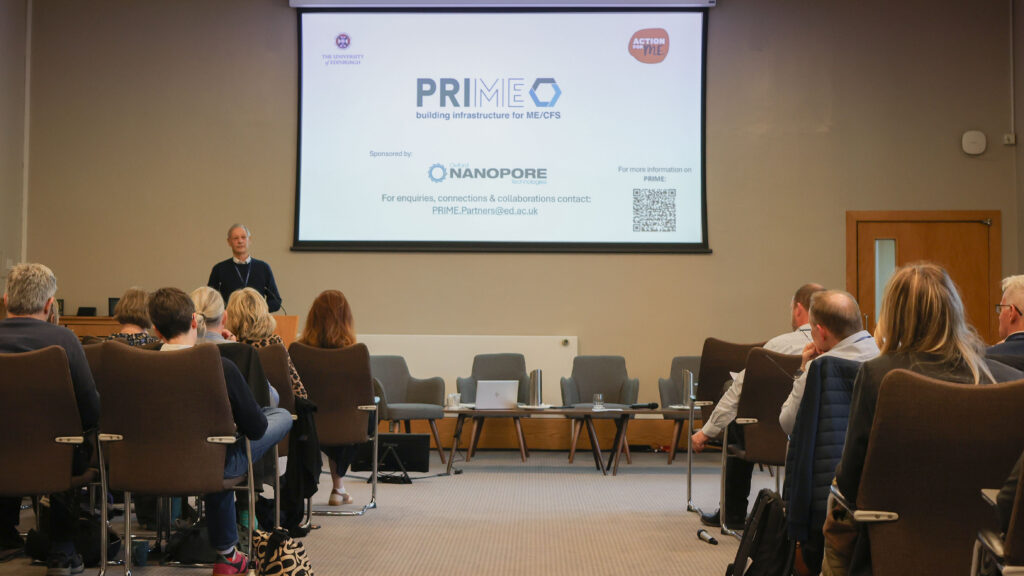
Researchers, clinicians, industry representatives, charities and people with lived experience came together at the inaugural PRIME International Symposium on 28 and 29 September 2026, a two-day event focused on accelerating progress in ME research through collaboration and shared learning.
Held in Edinburgh and online, the symposium provided a unique opportunity to bring together expertise from across disciplines to explore emerging research, discuss priorities for the future, and identify new opportunities for partnership and innovation.
Under the heading Building Momentum, the symposium showcased current developments across ME research while creating space for meaningful discussion between researchers, industry partners and people with lived experience.
The event reflected PRIME's commitment to developing the infrastructure, networks and collaborations needed to support high-quality research and accelerate progress towards better understanding, diagnosis and treatment of ME.
“PRIME is a confluence of academics, people with lived experience and industry representatives, all eager to advance ME/CFS research towards effective therapies. Its 2026 Symposium was a great success, and we look forward to suggestions how it can be improved next year!” Prof. Chris Ponting, Chair of Medical Bioinformatics, Univ. of Edinburgh
The first day focused on genetics and genomics, with speakers exploring how emerging discoveries may help researchers better understand the biological mechanisms underlying ME.
A key highlight was the official launch of the Genetic Epidemiology of ME/CFS (GEM) International Consortium, bringing together international expertise to advance understanding of the genetic factors involved in ME.
Attendees also took part in workshops examining how genetic findings can generate new research hypotheses, while early career researchers presented a series of flash talks showcasing the next generation of ME research.
The afternoon included discussions about the most important questions facing the field, alongside industry perspectives on the opportunities and challenges involved in translating research findings into tangible improvements for people with ME.
“Launching the GEM consortium in the PRIME meeting was a unique opportunity to get immediate feedback from researchers with very diverse expertise. Something like this normally would take multiple calls or a consulting company to manage. PRIME made an immediate impact on the speed that we can connect with other teams and with people with lived experience and above all move research in ME/CFS forward.” - Dr. Hanna Ollila - FIMM EMBL Group leader, Institute for Molecular Medicine, University of Helsinki
The second day focused on current research, impact, and the vital role that patient and public involvement plays in strengthening research quality and relevance.
Action for ME's Patient and Public Involvement team shared developments from the PRIME PPI Research Involvement Hub, highlighting the importance of ensuring that people with lived experience are involved throughout the research process – researchers are encouraged to engage with the hub from the project inception stage onwards throughout the project’s lifetime.
Attendees also heard preliminary findings from the Action for ME Big Survey, before taking part in workshops exploring priorities and perspectives from the ME community.
The programme concluded with presentations on a range of current research projects, including studies investigating post-exertional malaise, immunology, genetics and related areas of ME and Long Covid research.
Throughout the symposium, a consistent theme emerged: progress depends on collaboration.
By bringing together researchers, clinicians, industry representatives, charities and people with lived experience, the symposium created opportunities to share knowledge, challenge assumptions and build new partnerships that can help accelerate research.
The event also highlighted the value of meaningful patient and public involvement in shaping research priorities and ensuring that research addresses the needs and experiences of those most affected by ME.
Kelly McLellan, PPI Representative, PRIME Delivery Group said: ‘Patient expertise is finally shaping ME research and PRIME is trying to make patient involvement easier for everyone. It is also trying to create an inclusive research community that, much like the ME community itself, actively supports, communicates, and spreads understanding’
The PRIME International Symposium marked an important milestone, bringing together the people and organisations working to improve our understanding of ME.
As new collaborations take shape and conversations continue beyond the event, the relationships formed at the symposium have the potential to drive future research and accelerate progress for everyone affected by ME.
Looking ahead, PRIME will hold a second symposium in 2027 to build on this momentum. Symposium 2 will continue to showcase academic research, patient and public involvement (PPI) and industry engagement, while placing a greater emphasis on clinical practice and reporting on efforts to develop and identify replicated biomarkers. Alongside this, Action for ME will continue to champion research that puts lived experience at its heart.
Watch the 2026 PRIME Symposium, Edinburgh recordings on YouTube.