Sequence ME & Long Covid, a new research initiative designed to explore the root causes of Myalgic Encephalomyelitis (ME) and Long Covid using large-scale, long-read whole-genome sequencing. Building directly on the success of the DecodeME study, this project aims to unlock deeper genetic insights that could accelerate the development of diagnostics and future life-changing treatments. This proposed £20 million study will analyse the entire genetic code of 9,000 people with ME and 9,000 people with Long Covid.
Sequence ME & Long Covid, will be the world’s largest ‘long-read’ whole-genome sequencing study of any disease.
Why this research matters
ME and Long Covid are severely debilitating conditions that affect hundreds of thousands of people in the UK, and millions worldwide. Despite the profound impact on quality of life, research into the biological mechanisms behind these conditions has historically been under-funded and under-explored. There are no diagnostic tests, no effective treatments and few solid biological findings to point the way. Identifying variants associated with ME and Long Covid will reveal their biomolecular mechanisms, and existing drugs can be identified that target the actions of these genes, leading rapidly to effective treatments.
Partnership and collaboration
Co-led by Action for ME, the partnership includes the University of Edinburgh, Oxford Nanopore Technology (who will provide the long-read technology) and the European Bioinformatics Institute (EMBL-EBI) who have joined to seek funding for Sequence ME & Long Covid.
The analysis will be led by Professor Chris Ponting of the University of Edinburgh, and Professor Ewan Birney, CBE, of the European Molecular Biology Laboratory's European Bioinformatics Institute.
Together, this multidisciplinary team brings world-class expertise in genomics, bioinformatics, co-production and ME research.
Why we are co-leading Sequence ME & Long Covid
We co-led DecodeME, the world's largest genetic study of ME
We work directly with the ME and Long Covid communities
We ensure people with lived experience co-produce research
We connect researchers, funders, and people with lived experience
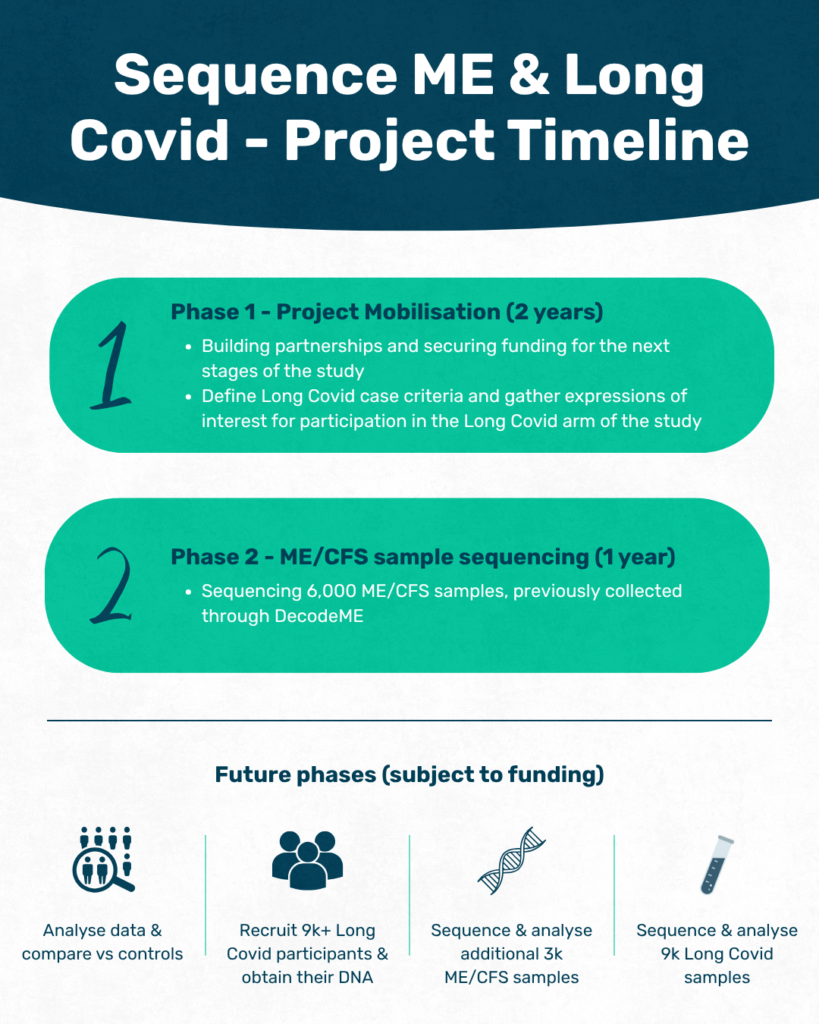
This funding supports project mobilisation and partnership development and will help secure funding for later phases. It will also support the development of the Long Covid arm of the study, including agreeing case definitions and gathering expressions of interest from people with Long Covid.
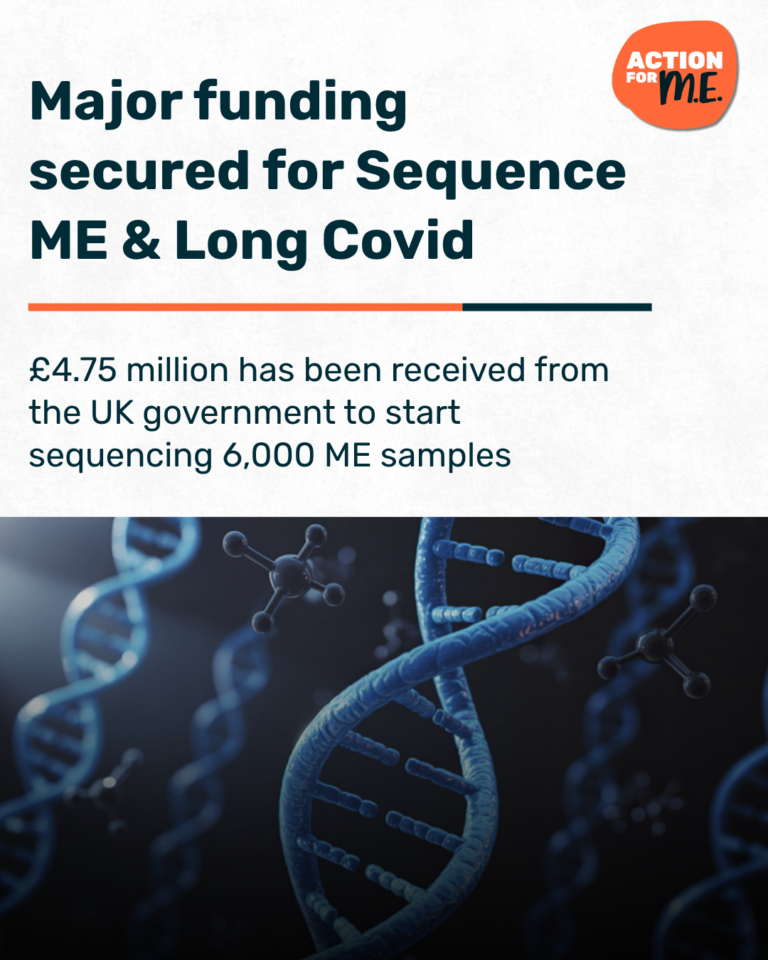
Additionally, funding for Phase 2 has recently been announced. This includes £4.75m of support from the UK government, as well as a generous donation of £174,414 from the WE&ME Foundation. Phase 2 will focus on sequencing 6,000 ME/CFS samples previously collected through DecodeME, using Oxford Nanopore’s long-read sequencing technology. This phase will run alongside Phase 1.
People with lived experience at the heart of the study
As with DecodeME, Sequence ME & Long Covid will ensure that people with lived experience of ME and Long Covid are central to the study. Patients and carers will be involved in shaping the research, guiding priorities and contributing to decision-making throughout the project.
What next?
The next phases of the study will depend on securing further funding.
These essential phases will include:
analysing sequenced samples and comparing them with controls
sequencing and analysing an additional 3,000 ME/CFS samples
recruiting people with Long Covid and
sequencing and analysing 9,000 Long Covid samples, including comparisons with ME/CFS and control samples.
Phase 1 and phase 2 will run simultaneously and fundraising for Phase 1 is ongoing, having already helped secure Phase 2 funding.
The DecodeME study conducted a GWAS analysis of genetic data from over 15,000 people with ME. The study identified eight genetic regions associated with ME, marking a major step forward in understanding the condition’s biological roots. DecodeME examined around one million common genetic locations across the genome. This is the first robust biological evidence pointing to the immune and neurological drivers of ME. But a GWAS is only the beginning, capturing a small proportion of the complete variation within the human genome. To identify causal variants, we urgently need to sequence the whole genome.
What is long-read whole-genome sequencing?
Whole-genome sequencing reads a person’s complete DNA sequence, providing a comprehensive picture of their genetic makeup.
Sequence ME & Long Covid will use long-read whole-genome sequencing, a more advanced and informative approach than the short-read methods typically used in large studies. Long-read whole genome sequencing allows researchers to:
locate genes with much greater accuracy
identify new biological mechanisms
reveal the epigenome in people with ME (chemical modifications to DNA and proteins that regulate gene activity)
detect rare genetic changes that are difficult to see with other techniques
identify structural variations such as missing, duplicated or rearranged sections of DNA
These rare and structural genetic changes are known to play a role in many diseases and may be especially important in complex conditions like ME and Long Covid.
By broadening our understanding in this way, Sequence ME & Long Covid aims to pinpoint potential targets for treatment and bring us closer to meaningful clinical advances.
Supporting this research
With a total investment of £20 million, this once in-a-generation study could transform our understanding of ME and Long Covid, leading to new treatments and placing supporters at the forefront of a medical breakthrough with true global impact.
If you would like to share any ideas or contacts for potential donors or partners who can help support the study, please contact our Research team.
Donate to Sequence ME & Long Covid
Donate now to help us move one step closer to deeper genetic insights into ME and Long Covid.
Sequence ME & Long Covid is led by the three DecodeME Investigators who form its Management Team: Sonya Chowdhury, Chief Executive of Action for ME; Professor Chris Ponting, Chair of Medical Bioinformatics at the University of Edinburgh; and Andy Devereux-Cooke (Public and Patient Involvement representative).
The Sequence ME & Long Covid partnership also brings in additional partners: Oxford Nanopore Technologies, which provides advanced long-read sequencing technology, and the Bioinformatics Institute, a global leader in large-scale biological data analysis and storage.
Different phases of the Sequence ME & Long Covid study will be project managed by the partners best equipped to deliver them. Project mobilisation (phase 1, with partial funding secured) is led by Action for ME. Sequencing of ME/CFS samples (phase 2, with full funding secured) is led by the University of Edinburgh. Professor Ewan Birney (European Bioinformatics Institute (EMBL-EBI) Director)will lead the analysis of sequencing data, including comparisons with population controls (phase 3, subject to funding).
DecodeME used a genome-wide association study (GWAS) to identify common genetic variants associated with ME/CFS susceptibility. It found 8 genomic regions linked to the condition.
Sequence ME & Long Covid builds on this work by using long-read whole genome sequencing. This approach is a thousand-times more detailed than GWAS. It identifies: rare genetic variants that are not usually captured by GWAS, structural variation in DNA, such as insertions, deletions and repeat expansions and other complex regions of the genome that are difficult to resolve with standard GWAS methods. The Oxford Nanopore technology also indicates chemical modifications of DNA.
We do not plan to recruit additional participants with ME/CFS. This is because we will use the samples already collected from people with ME/CFS throughthe DecodeME study. During the initial project mobilisation and development phase, we will work to define the specific research case criteria for Long Covid. We will also invite expressions of interest from UK-based individuals with Long Covid who may wish to participate in the study. Subject to securing sufficient project funding, we aim to recruit 9000 people with Long Covid who meet the defined research criteria into the SequenceME & Long Covid study.
Unfortunately, no. Sequence ME & Long Covid is specifically designed for people with ME/CFS and people with Long Covid, based on defined research criteria.
If you have a different condition (and do not have ME/CFS or Long Covid), you will not be eligible to take part in this study.
The goal of genetic and biological research likeSequenceME& Long Covid is to discover biomarkers and underlying mechanisms that couldeventuallybe developed into diagnostic tests. However, sequencing itself is not a clinical test -it’sa research tool. Turning these discoveries into reliable medical tests will takeadditionalvalidation and further clinical studies.
A core aim of SequenceME & Long Covid is to identify genes and pathways that can potentially be targeted with drugs. Once biological drivers are understood, researchers can investigate whether existing medicines might be repurposed or whether new treatments can be developed and tested. This process can be long and iterative, but genetics tends to speed up this process and can give clear direction for targeted research.
We are including Long Covid because many people with Long Covid experience symptoms such as post-exertional malaise, cognitive difficulties and persistent fatigue, which are also core clinical features of ME/CFS, suggesting potential overlapping biological mechanisms. Studying both conditions within SequenceME & Long Covid will allow researchers to better understand where the conditions overlap and where they differ. It will also maximise the value of the research and increase the potential to identify meaningful biological pathways that could inform future diagnostics and treatments.
Around 9,000 participants each for ME/CFS and Long Covid is a strong and well-powered sample size for wholegenome sequencing: large enough for meaningful genetic discovery while remaining scientifically and financially realistic. Taken together, the ME/CFS and Long Covid arms of SequenceME & Covid would represent one of the largest long-read sequencing efforts in any disease to date. It also means that samples remain available for investigation by potential projects in the future. To sequence more than this would require additional funding and we do not feel that is necessary at this stage.
DecodeME collected 15,000 saliva samples from people with ME/CFS. Half of each sample was used for DecodeME’s initial genetic analysis. The remaining half was stored for other activities such as Sequence ME & Long Covid. Sequence ME & Long Covid plans to use 9,000 of these samples. They will also use data from the DecodeME questionnaires completed by all participants.
Your involvement in DecodeME is helping to improve understanding of ME/CFS and Long Covid.
SequenceME & Long Covid sits within the existing DecodeME research framework. Participants in DecodeME consented to their DNA samples being used for genetic research, including whole-genome sequencing.All data will continue to be managed in line with the University of Edinburgh's data protection obligations and established governance and oversight procedures for the DecodeME study.
To ensure reliable results, genetic studies must closely match participants with and without the condition by ancestry. If groups are not well matched, observed genetic differences may reflect ancestry rather than the condition itself.
The study team will define the scientific and practical requirements for the Long Covid component in due course. This will include setting the eligibility criteria for recruiting at least 9,000 participants with Long Covid. Action for ME will share updates on how to take part through its website, newsletter and social media channels once this information is available.
At present, it appears unlikely that people living outside the UK will be able to participate. This is due to the additional complexity and higher cost of recruiting and processing samples from outside the UK.
technology. This phase will run alongside Phase 1.
The project has recently launched, and the initial funding is supporting essential groundwork such as defining Long Covid criteria and establishing partnerships. Sequencing of the 6,000 ME/CFS samples has also now begun and will take one year. As further funding is secured, the study will expand to include analysis of the data from the initial 6,000 ME/CFS samples, additional sequencing, and the recruitment of people with Long Covid. The team will share updates as the project progresses, including through webinars. However, timelines for results and publications will depend on funding and the pace of the research.
Join our newsletter mailing list for updates on our latest activities, news, and campaign information. Simply fill in the below form to receive regular updates from us.
Need to get in touch?
Call us on 0117 927 9551 or email [email protected] to speak with a member of our Information & Support team.
Or, find out how you can speak to another one of our friendly teams, such as our Fundraising or Marketing teams
Getting the right information supports informed decision-making. If you’re newly diagnosed or looking for reliable information about ME, this is the section for you.