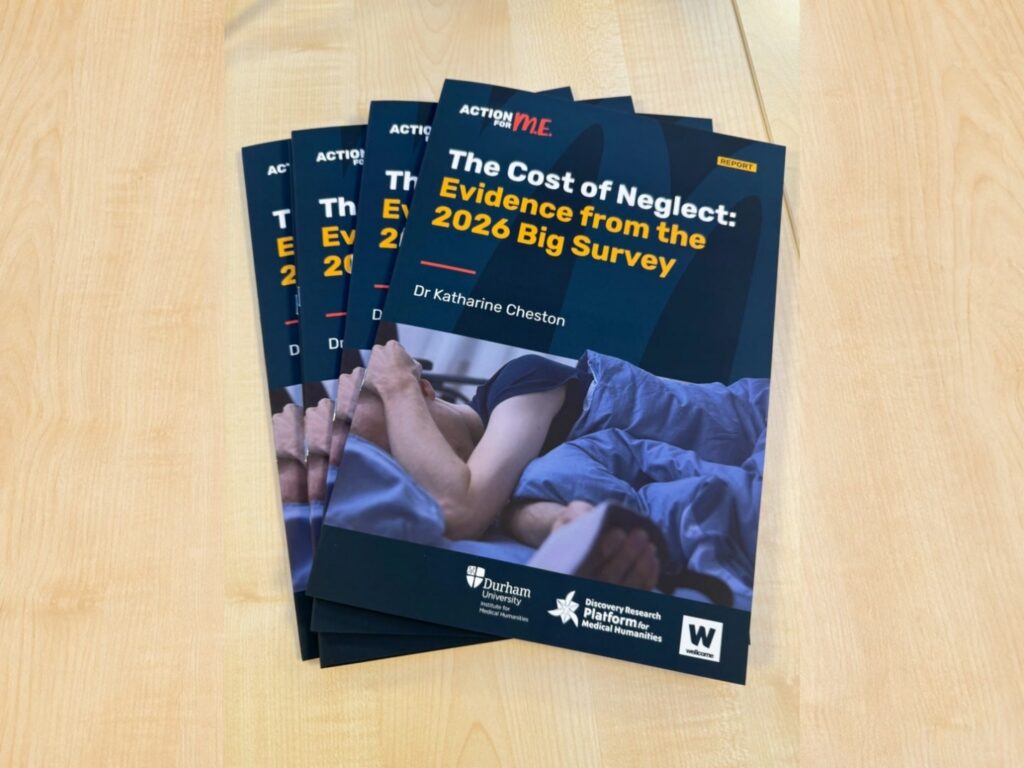
Our new report reveals the devastating human and economic consequences of decades of inaction, with thousands of people experiencing inadequate healthcare, unmet social care needs and barriers to employment.
The Cost of Neglect: Evidence from the 2026 Big Survey, produced in collaboration with Durham University's Institute for Medical Humanities, draws on the experiences of more than 5,000 people affected by ME.
Participants contributed nearly 750,000 words of written testimony, revealing the impact of ME on their lives and the continuing failures of the systems meant to support them.
The findings demonstrate the urgent need for meaningful action from government, healthcare providers and other institutions.
ME has a devastating impact on people's ability to work and participate in society. Two in five (41%) respondents said they were unable to undertake any paid work because their ME was too severe, while just 8.3% were working full-time.
The economic consequences are substantial. Reduced labour-force participation associated with ME and ME-like symptoms is estimated to cost the UK economy £19.66 billion every year, equivalent to approximately 0.68% of GDP.
Behind these figures are people whose careers, education and financial independence have been profoundly affected by illness.
Our findings reveal widespread failures in NHS healthcare, with 85.1% of adult respondents reporting that they receive no ongoing support or follow-up care for their ME.
Those with the most severe illness often face the greatest barriers to accessing appropriate care. Almost two-thirds (64.5%) of respondents with very severe ME described their experiences of NHS healthcare as 'traumatic' or 'traumatising', compared with 22.7% of those with mild ME.
People who need healthcare the most are too often the least able to access it, with inadequate services and previous negative experiences leaving many without the support they need.
The survey also reveals the devastating consequences of unmet social care needs.
More than two-thirds (69.3%) of respondents with social care needs said those needs were not being met. As a result of inadequate support, half (50.1%) struggled to prepare nutritious food, while almost half (46.7%) were unable to manage their personal care to the standard they would want.
These are fundamental aspects of everyday life. Without appropriate support, people with ME are being denied the independence, dignity and quality of life they deserve.
Sonya Chowdhury, Chief Executive of Action for ME, said:
“People with ME have waited decades for meaningful change, while the systems meant to support them continue to fail. This report lays bare the devastating human and economic consequences of that inaction.
“The Government has acknowledged the need to improve ME care, yet too many people remain without appropriate healthcare and essential support. Commitments mean little unless they translate into real improvements in people's lives.
“Enough is enough. We need urgent action to address these systemic failures, ensure people with ME receive the care and support they need, and deliver sustained investment in biomedical research.”
Dr Katharine Cheston, Researcher at Durham University's Institute for Medical Humanities, said:
“Behind every statistic in this report is a person whose life has been profoundly affected by ME. The nearly 750,000 words of testimony shared by participants give us an extraordinary insight into the realities of living with this illness, and the impact of being repeatedly let down by the systems meant to provide care and support.
“These accounts are often deeply moving, revealing not only the devastating consequences of neglect, but also the determination of people with ME to have their experiences heard and taken seriously. Their voices must be central to how we understand the illness and how we respond to it.”
The Cost of Neglect: Evidence from the 2026 Big Survey was presented to parliamentarians on 25 November 2026, ahead of its public launch on 26 November.
Explore the full findings, the experiences shared by survey participants and our calls for meaningful change.